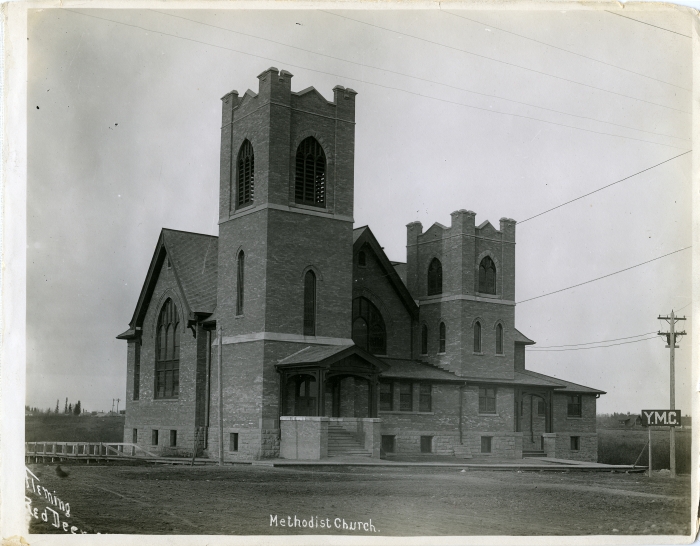
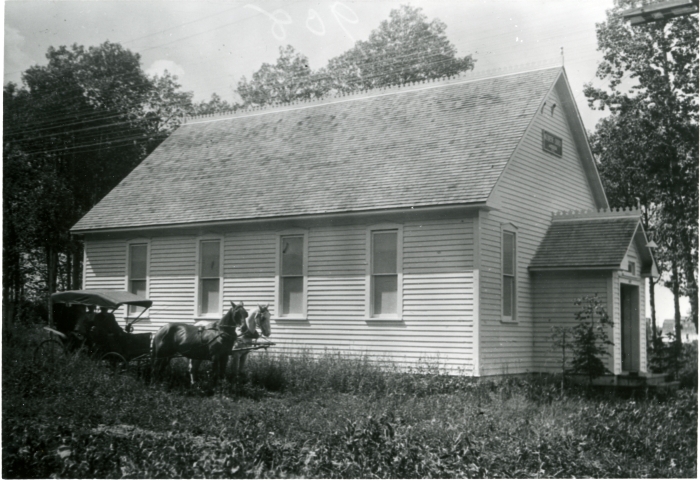
P3214, Methodist Church, 1940
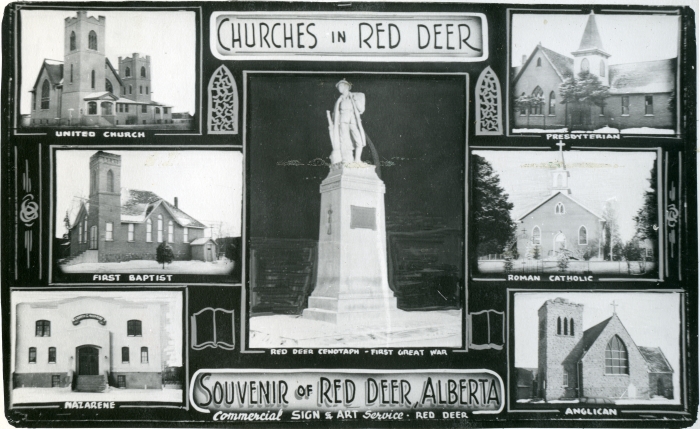
This page highlights churches with related records held at the Red Deer Archives. It is not intended as a comprehensive listing of all church history in the city, but rather as a resource for exploring the materials available at our archives.
United / Methodist
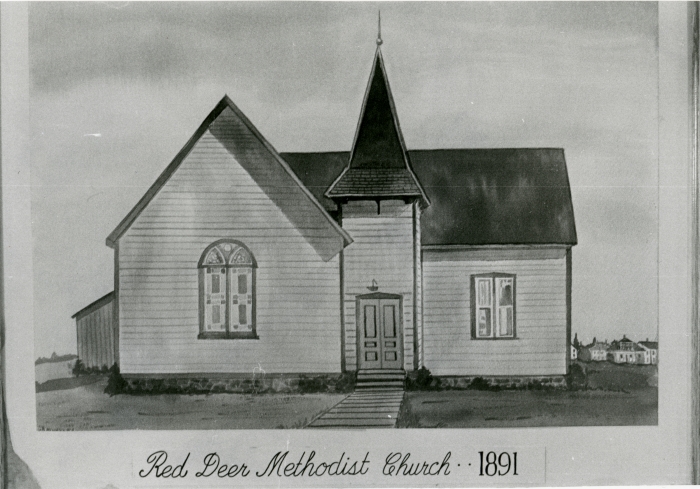
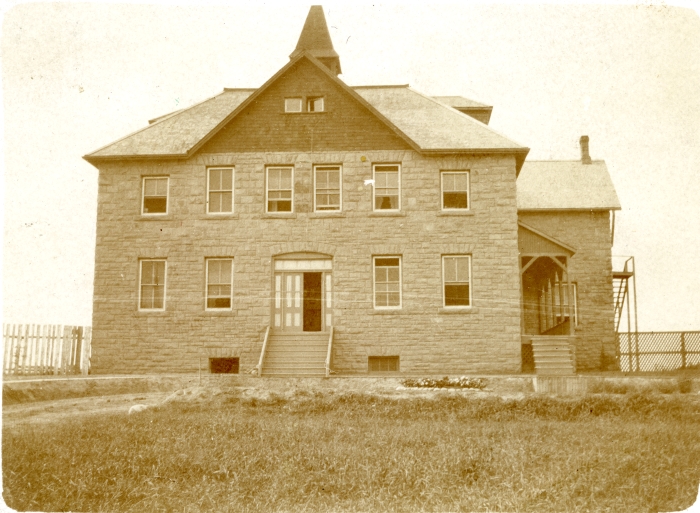
The United Church of Canada was formed in 1925 from the union of the Methodist, Congregational, and most Presbyterian churches. The Methodist church has a particularly influential history in Red Deer. Reverend Leonard Gaetz was a retired Methodist minister and a land agent for the Saskatchewan Land and Homestead Company when he established the settlement of Red Deer. In 1886, a student missionary named William Vrooman arrived in Red Deer to serve as the community’s first Methodist minister. The Methodist church also established and ran the Red Deer Indian Industrial School, a residential school, just outside Red Deer from 1893 to 1919.
A church was built in 1892 and enlarged and renamed the Leonard Gaetz Memorial Methodist Church in 1909. After the church voted in favour of union, the building became the Gaetz Memorial United Church in 1925. The building was destroyed by fire in 1955, including the original pipe organ and most of the church’s records. The church was rebuilt and re-dedicated on October 7, 1956, and due to the pipe organ, acoustics, and aesthetics it has become a frequent host to many community concerts.
Sunnybrook United Church was established in 1964 and has been a key host for the Remembering the Children Society. Blackfalds United Church operated from 1902 to 2019. Associated organizations include the Canadian Girls in Training (CGIT) and Kasota East Camp at Sylvan Lake.
Presbyterian
The Presbyterian church originally started with traveling preachers, including Reverend A.B. Baird who held services at the Red Deer River crossing. In 1887 A.E Neilly was the first official appointee to Red Deer, establishing a public school which was then taken over by Reverend Leonard Gaetz when Neilly left. In 1891 Reverend James Fleming was assigned to serve the Innisfail and Red Deer area. Innisfail, then known as Poplar Grove, established the congregation and manse for St. Andrew’s Presbyterian Church in 1891. They rebuilt and moved it twice before finding a final location at 4716 50 Avenue, Innisfail, in 1947.
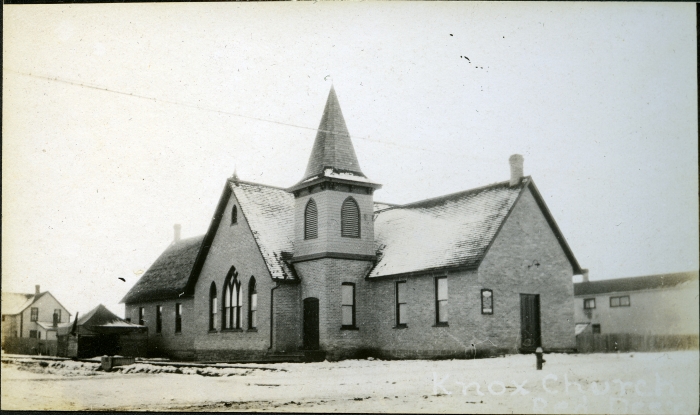
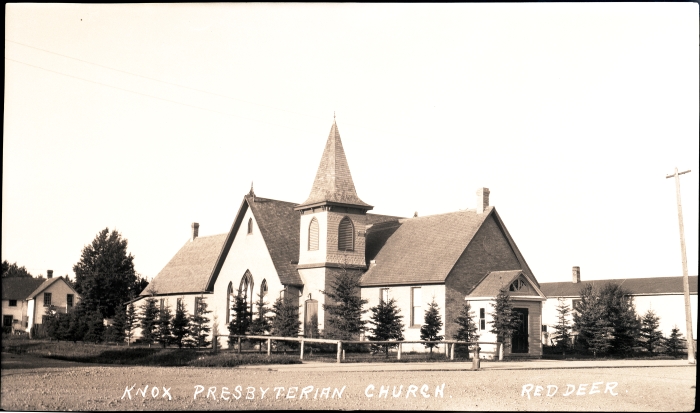
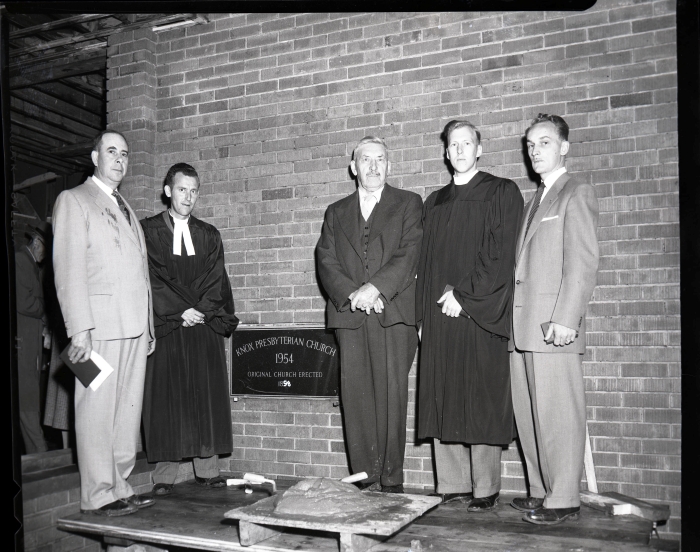
In Red Deer, the first church Session was constituted on August 14, 1898, and the first Knox church was built at 49 Avenue and 48 Street in 1898. There were major additions and renovations including in 1915. In 1949, plans started for a new church on a new site. The new Knox church opened at 4718 Ross Street in 1954.
Anglican
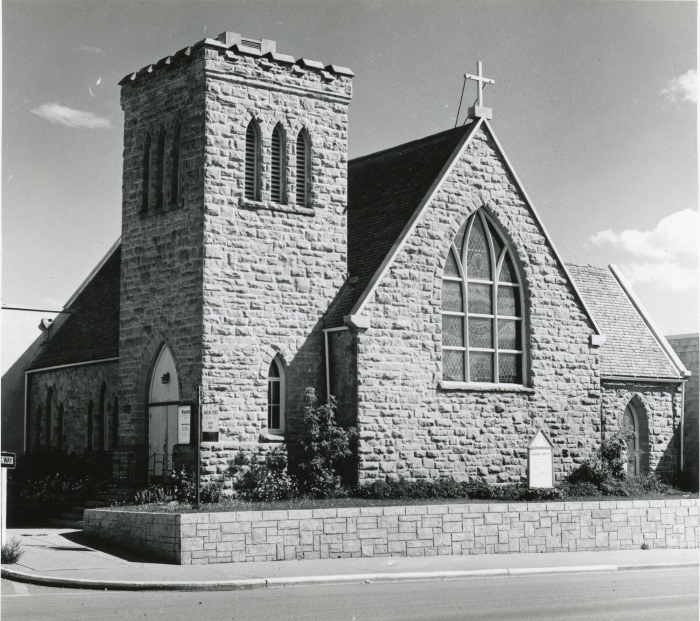
One of the oldest church buildings in Red Deer is St. Luke’s Anglican Church, established as St. Luke’s Parish in 1892. Thanks in part to Reverend Joshua Hinchliffe’s training as a stone mason, the sandstone church construction started when the cornerstone was laid on September 4, 1899 by Bishop Cyprian Pinkham. All Masonic Lodges in Alberta were invited to the event and the Red Deer Masonic Lodge was also reinstituted that day. The church opened in 1904 and was designated as a Registered Historic Resource in 1977, a Municipal Historic Resource in 2009, and a Provincial Historic Resource in 2012.
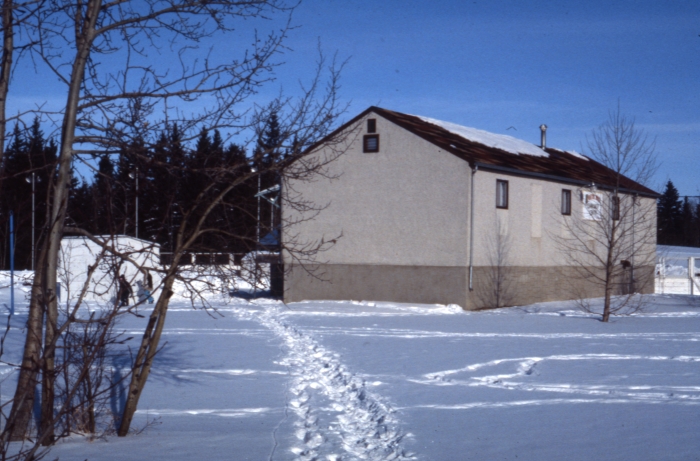
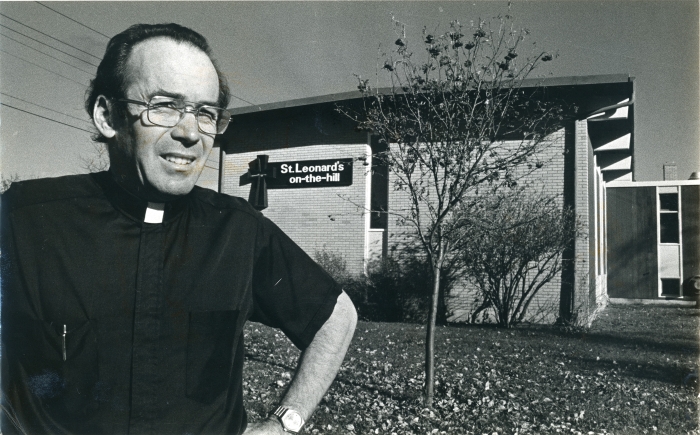
St. Paul’s Hillsdown Anglican Church was established about 26 km east of Red Deer in 1899, with a church built in 1905. The church burned down by a prairie fire in 1910, and reopened in 1911. They established what became Hillsdown cemetery. St. Leonard's-on-the-Hill Anglican Church started in 1954 as a Sunday school in the St. Luke's parish's Mountview Hall in Red Deer, Alberta. In 1959 the present church was dedicated.
Lutheran
The first Lutheran churches in the area were established by settlers outside Red Deer including Burnt Lake and Markerville. And while they all used “Lutheran” in their names, they were organized under shifting affiliations with various synods and conferences and offered services in a variety of languages.
The Markerville Lutheran Church was established in Markerville in 1907 by Icelandic settlers. Rev. Peter Hjalmsson was the first minister of the church, serving the congregation until 1935. After his departure services were held by visiting clergy, and the church is still used today for special events. Lutheran services in Red Deer were held in a variety of buildings in the early years. Mount Calvary Lutheran was the first Missouri-Synod affiliated Lutheran church built in Red Deer, organized in 1946. Its sister congregation Trinity United Evangelical Lutheran Church formed in 1952. The Lutheran Church of the Good Shepherd was organized in Red Deer in 1985 and its house of worship was dedicated in 1990.
Church of the Nazarene
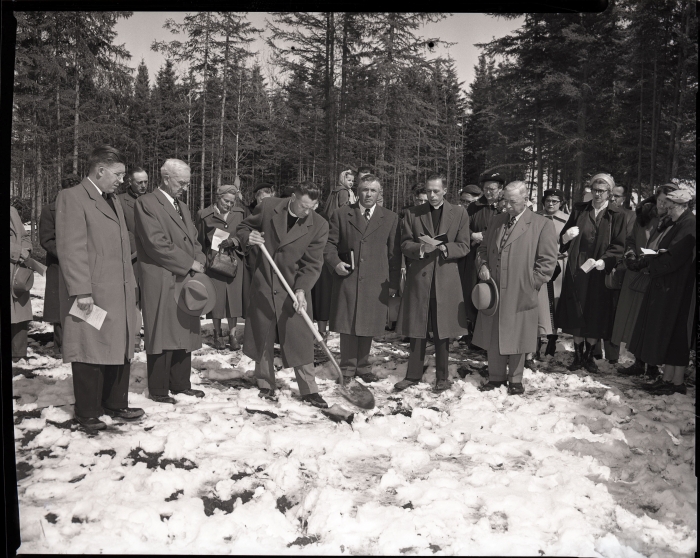
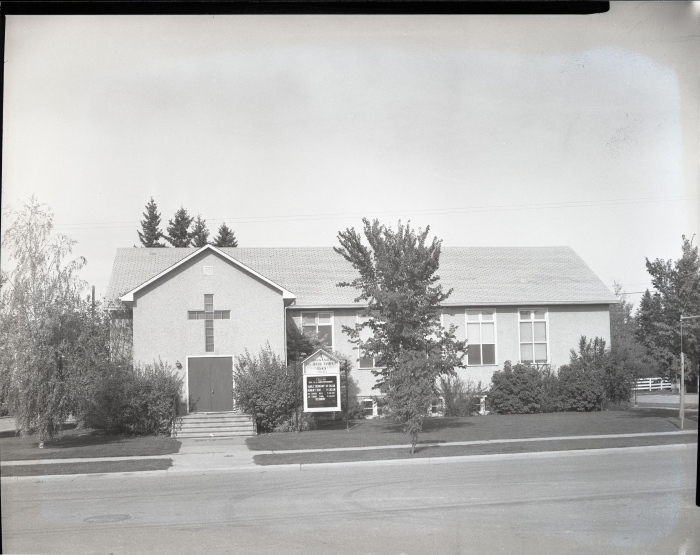
After founding a Church of the Nazarene in Calgary, in the fall of 1912 Reverend Thomas Bell moved to Red Deer. Two lots on Ross Street at the foot of Michener Hill were donated as a site for the church, which opened on January 5, 1913 and was followed by an interdenominational holiness convention and a week of revival services. After several more revival camps, including services in tents, in 1920 the church building was moved to 48 Avenue and 48 Street. In 1918, a group of Presbyterians from Nova Scotia settled in the Hillsdown area near Delburne, Alberta. Unable to attract a Presbyterian pastor, they invited a Nazarene pastor to lead their worship instead. They built the Cumberland Church of the Nazarene in 1919 at NE 20-37-24 W4. The church closed in 1962.
In 1927, the Alberta School of Evangelism was established in Red Deer. Originally located at the Spingbett house on 48 Street, it moved south of 45 Street near Gaetz Avenue (near Piper’s Mountain) and was renamed the Northern Bible College. In 1940 became the Canadian Nazarene College. The campus was sold in 1961 and the institution was centralized in Winnipeg. It eventually moved back to Calgary and became Ambrose University.
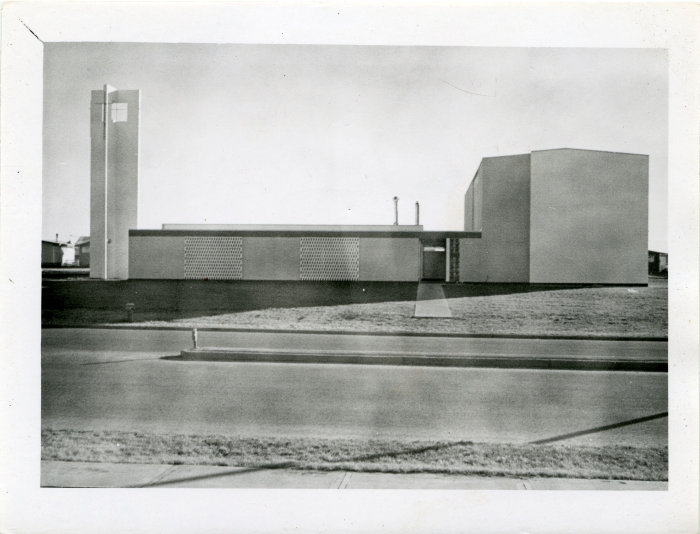
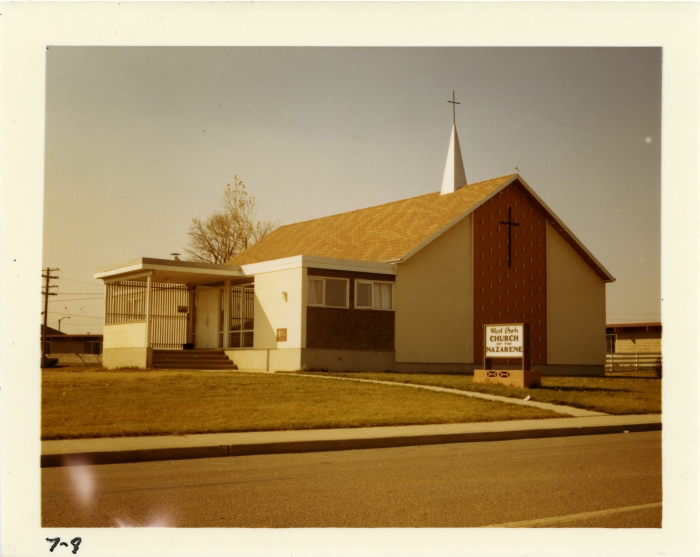
In 1963, a new building for the First Church of the Nazarene was constructed on 40 Avenue and McVicar Street. Meanwhile, in 1962, the West Park Church of the Nazarene was formed, originally using a building purchased from the Salvation Army.
Roman Catholic
The first Roman Catholic priest in what would become the central Alberta area was Father Jean Baptiste Thibault who visited Rocky Mountain House in 1842. The next significant priest was Father Albert Lacombe who came to central Alberta in 1855. He was followed by Father Constantine Scollen who built a log mission house along the Calgary-Edmonton Trail. It was located west of the current site of the Penhold airport on what became known as Mission Hill, and served as a stopping place for Catholic priests until the railroad was built.
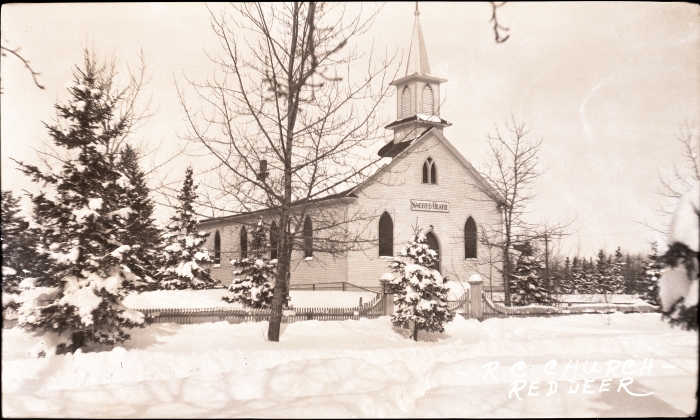
In 1904, the Fathers of Ste. Marie of Tinchebray left France and came to Innisfail and then Red Deer. In 1905, their head, Father Henri Voisin, began construction of Sacred Heart Parish opening August 28, 1905 on Alexander (48) Street west of Gaetz Avenue. In November 1909, they started a second church, this time on Mission Hill, also named Sacred Heart. It was renamed Our Lady of Sorrows in 1918. Mount Calvary Catholic Cemetery was also established in 1909 to serve this parish and had its first burial on October 9, 1911. In 1925, a new Sacred Heart Church was built on 55 Street. Parish growth led to building a new church beside the old building, which officially opened on August 12, 1959.
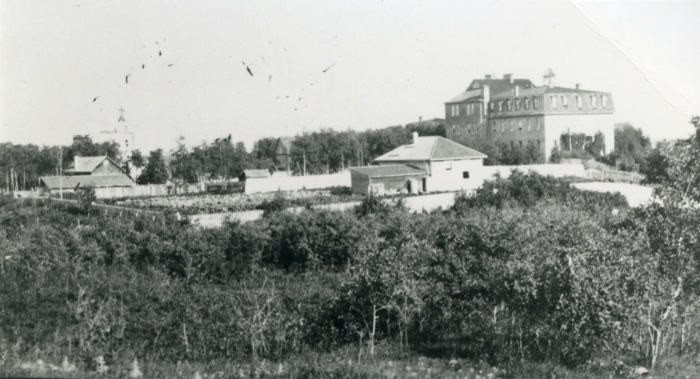
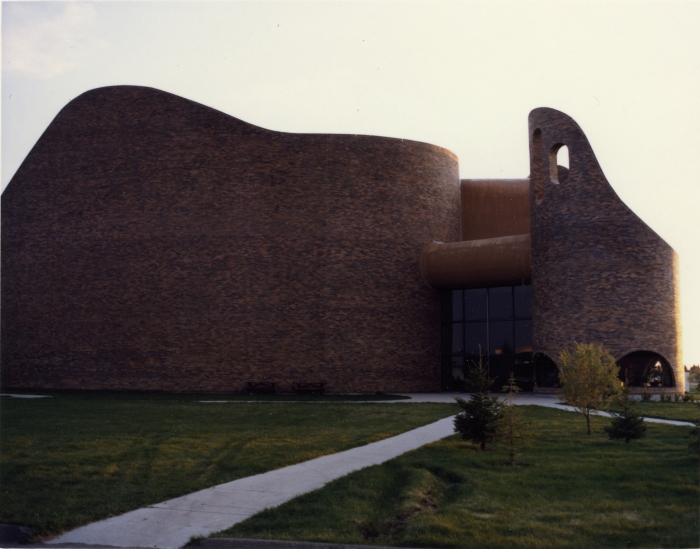
Following the encouragement of Father Voisin, the Daughters of Wisdom (Filles de la Sagesse) started St. Joseph Convent boarding school in the village of North Red Deer, formally establishing the Red Deer Roman Catholic School District on January 8, 1909. They expanded into the old St. Mary’s Apostolic College building to the west during the First World War. In June 1960, due to inadequacies with the classroom space, the classrooms at the school were closed. The boarding program ended in 1962. The original convent building was demolished in the late 1970s, with a new house blessed in 1978. That building was in turn closed in 2005 and demolished in 2007. With the growing Catholic population a new church was needed. Originally proposed as St. Thomas Aquinas Parish in 1963, St. Mary’s Church was established on September 6, 1964 and the building, designed by Douglas Cardinal, officially opened December 8, 1968.
Access the research guide to learn more about church records.