Public Education
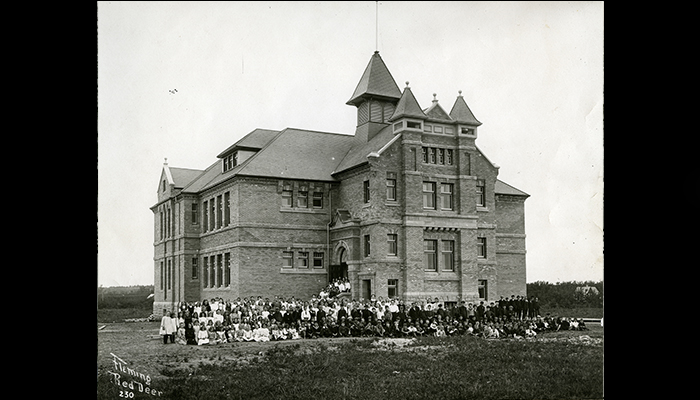
Red Deer Archives, P2710
The Red Deer Central Protestant Public School District No. 104 was officially created by the Northwest Territories Department of Education on September 12, 1887 with three school trustees. The first school between Calgary and Edmonton was erected at the Red Deer River crossing near Fort Normandeau the same year. The schoolhouse served as both school and church until 1893 when the school was moved into the new village of Red Deer and the district renamed Red Deer Public School District. The following year a two-storey brick school was built.
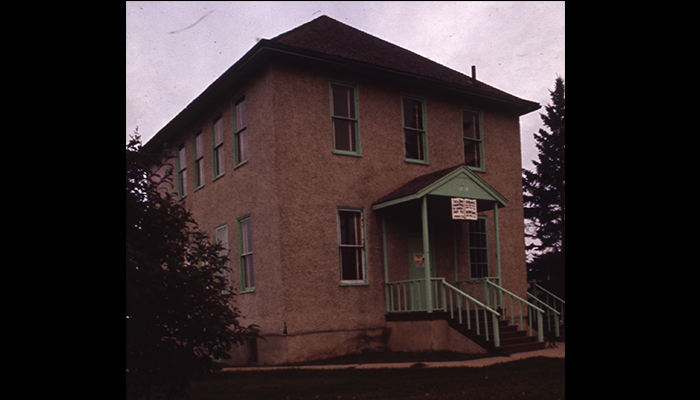
Red Deer Archives, S8544
By spring 1905 the population of the new Town of Red Deer had grown so much the school board was renting space in the Orange Hall for classrooms, and by December they were again looking for additional space. In 1907 another eight-room school was constructed rather than adding to the existing school. The new Central Public school (later nicknamed the “Castle”) initially accommodated all grades until the senior grades (grade 9-12) were moved back to the original 1893 school. As the population continued to grow, the twin North and South Cottage schools were built in 1912 to accommodate new students.
Red Deer Archives, P2836
Prior to the First World War, the Red Deer economy was strong, attracting many highly qualified teachers. At one point all the high school teachers had a university degree, which awarded them a higher salary. In 1912, the District even had the luxury of employing a music teacher. But by 1914 the teachers were offering to take a salary reduction, and the role of truancy officer was taken on by the Chief of Police. More and more teachers resigned to enlist in the war effort, including women. By 1917 the school district had only 15 staff with one male principal.
Through the 1920s the student population continued to grow. The Red Deer school board struggled to retain teachers with salaries fluctuating from year to year. The Central school needed additional classrooms, and the West Park neighbourhood was petitioning for a new school. Despite the dire need for more space, Red Deer ratepayers opposed the construction of any new school building, so classes continued in roughly converted spaces. At the time, the high school principal was also principal of the entire school system. In 1925, Joseph Welsh was given authority over all classes in grade one to eight, under the supervision of the principal. As provincial grade eight examinations were optional, Mr. Welsh’s sole recommendation determined who was promoted to high school.
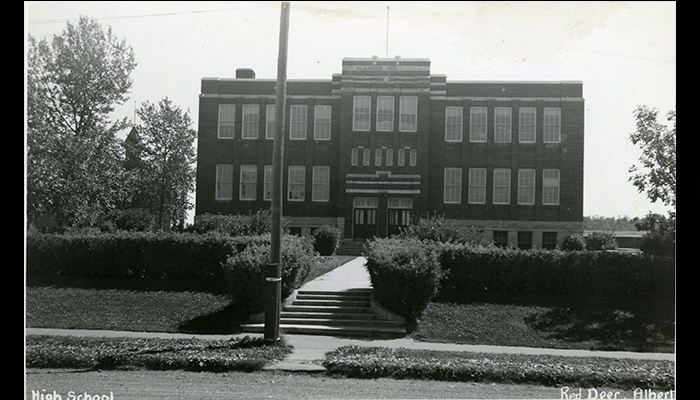
The new Red Deer High School, completed in 1928, could accommodate 176 students. With the onset of the depression era, teachers and caretakers’ salaries were again reduced while senior student enrolment increased, likely due to the lack of employment which had previously pulled students away from school. Legislation in 1936 created school divisions governed by a three to five member elected board. This new board was responsible for the hiring and payment of teachers and the operation of all buildings. The superintendent was hired and paid by the provincial government.
Red Deer Archives, P1873
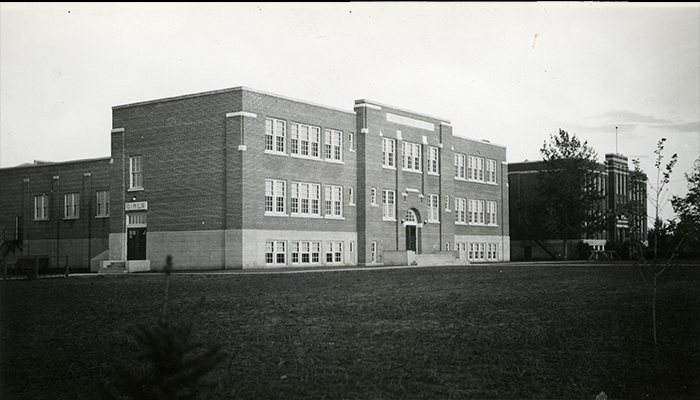
The outbreak of the Second World War initially had little impact on education in Red Deer. The new Intermediate School opened in 1940 for grades seven to nine and total school enrolment was 799 students. An agreement between the Red Deer Public School District and Innisfail shared the duties of a shop teacher and home economics teacher, and there were several temporary school closures due supply shortages. But as the war dragged on it created a shortage of male teachers, the Innisfail teachers found it increasingly difficult to travel to and from the city, and student enrolment continued to increase. Prior to 1942 it was the Board’s policy to not hire married female teachers, but for the duration of the war this policy was temporarily halted. Women were hired on one-year contracts, but in practice they continued as regular staff.
Red Deer Archives, N1643
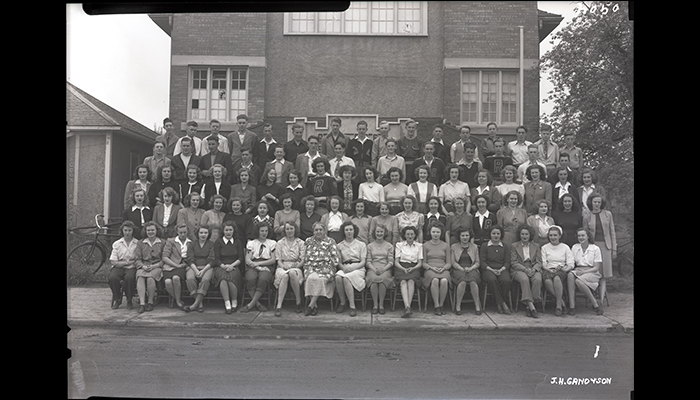
After the war, Red Deer again experienced a boom. Enrolment was up to 1061 students in 1946, and the new Composite High School was organized under Red Deer School Division No. 35. Dormitories were provided for the out-of-town students. Between 1951 and 1964 ten new elementary schools and two junior high schools were opened. For the first time the school board and the City worked together on the development of McLean Field. The Red Deer Junior College also opened in 1964 in the Composite High School, with the public school district in charge of administration.
Red Deer Archives, N5929
Student population growth meant more schools and classrooms, but also meant changes within the school district administration. For the first time, in 1956, permission was granted to hire Catholic teachers for positions in the public schools, the boundaries of the City of Red Deer and the school district were finally aligned (Eastview Middle School had technically been built outside the city limits), and in 1967 the Teachers-Board Liaison committee was formed.
Even more big changes came in the 1970s. The school board was increased from five members to seven. The age for entering grade one was adjusted, and rigid school attendance boundaries were abolished. An alternative junior high school program was introduced where students were placed in locations outside of regular school to receive individual instruction. The City of Red Deer, along with the Public School Board and Catholic School Board, collaborated on a new community centre concept, the G.H. Dawe Centre. By the end of the decade, attempts were made to introduce a standard system of grading for all schools based on a prescribed guideline.
One of the most significant changes made to Red Deer public schools happened in 1994 when the Government of Alberta created regionalized school districts, and the entire Red Deer Public School District was reorganized. Elementary schools would now include grades 1-5, middle school grades 6-8, and high school grades 9-12.
The Red Deer public schools have been leaders in innovative programming and building design.
When Glendale Junior High School opened in 1985, it was the first school in Red Deer to utilize a unique layout, take advantage of different building materials, and include a computer lab, music room, and drama centre. Superintendent Len Luders introduced a high school technology preparation program in 2000 and in 2009 Glendale School moved to a science and technology focused program, providing laptop computers to all students in grades five to eight. The Micro Society program at Aspen Heights Elementary School was the first of its kind in Canada. When Westpark Middle School reopened in 2019 it was built to Leadership in Energy and Environmental Design standards and included the first solar chimney in a school in Alberta. Normandeau School has the only passive solar greenhouse in central Alberta.
In 2019, the Alberta government removed the word public from the name and the board officially became Red Deer School Division Board. Today, the division is governed by a board of seven locally elected trustees and is responsible for 11 elementary schools, three middle schools, three kindergarten to grade eight schools, two high schools, three alternative schools, and over 11500 students and 1400 staff.
The Composite and Vocational School
The first composite high school for rural students in Western Canada was established in Red Deer by the Red Deer School District No.35 (responsible for the dorms and the vocational section) and the Red Deer Public School District No. 104 (responsible for the academic section). Courses included senior classes required for university, metal work, electricity, home making, and commercial (secretary, stenography, shorthand, etc.). A unique trimester system was approved for the 1949-1950 school year. This divided the school year into 3 equal terms, allowing rural students to work on farms in the fall and spring without missing school. It remained in place until 1980.
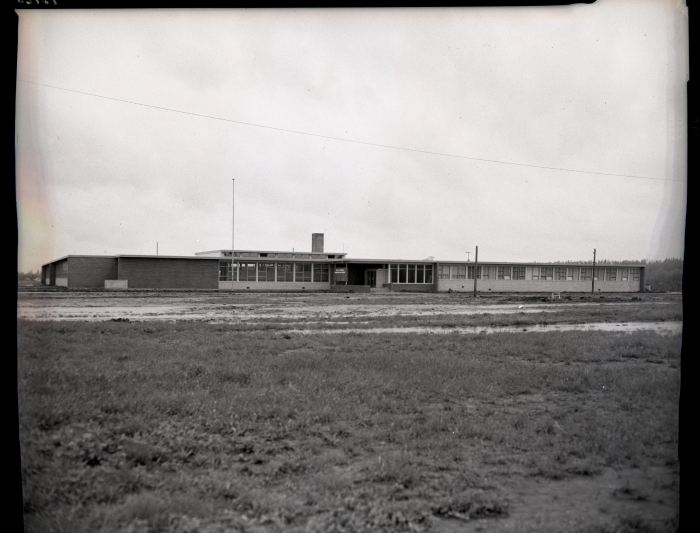
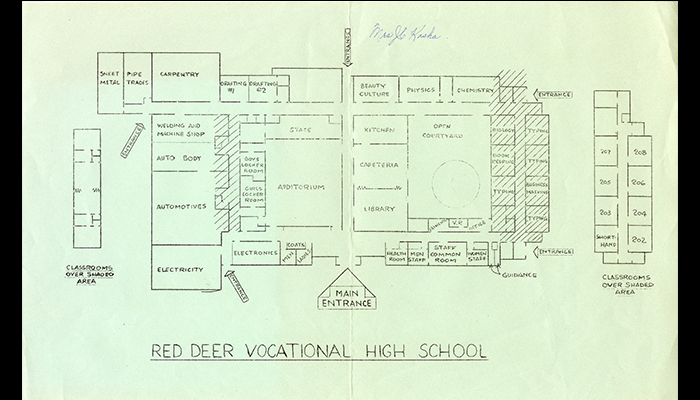
Next door, the Red Deer Vocational High School opened in 1963 and was amalgamated with the renamed Lindsay Thurber Comprehensive High School in 1967.
Red Deer Archives, K23123
G.H. Dawe Centre
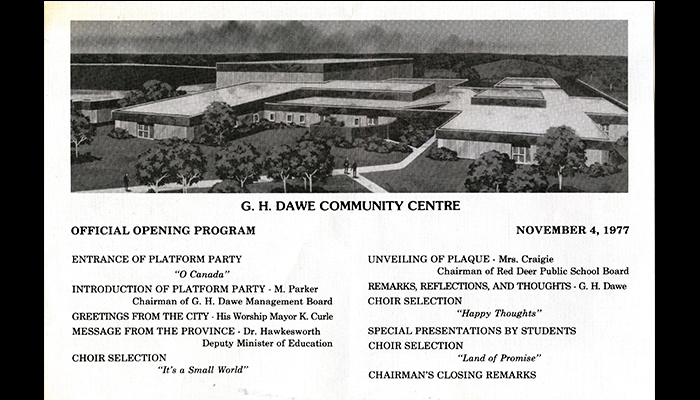
By the mid 1970s the Provincial Government had begun to support joint educational and recreational facilities with significant community involvement. In May 1976, a joint use agreement was signed by the Red Deer Public School Board, the Red Deer Separate School Board, and the City of Red Deer. It was the first time in Alberta that three such public bodies had agreed to construct and operate a joint education and community complex including the G.H. Dawe Community Centre, G.H. Dawe Community School, and St. Patrick’s Community School. Phase one was built in 1977 and included a community school and public library. In 1980 phase two was completed with a public swimming pool. St. Patrick’s Community School and the arena were officially opened in 1981 and 1982.
Red Deer Archives, K56
Key dates:
1887-1920
1887 Red Deer Central Protestant Public School District No.104 was officially created. The first school was built near Fort Normandeau and the Red Deer River crossing. At one time 21 students were listed on the register.
1893 School classes moved to the space in Burch’s Hall in the Village of Red Deer.
1894 First school built in Red Deer. District renamed Red Deer Public School District.
1903 Registration was 220 students.
1907 New Central Public School opens for Grades 1-12. Later know as the “Castle” school.
1910 December. Alberta Legislature passes the Truancy and Compulsory School Attendance Act, requiring children to attend school from ages 8-13 for the full school term.
1910 Original 1893 school reorganized for senior grades only (Grade 9-12).
1912 Opening of North Cottage School and South Cottage School.
1918 Policy to only allow beginner admittance in the first two weeks of the fall term and the first two weeks in February.
1919 St. Luke’s Parish Hall used as classrooms.
1920 School enrolment was 624 students.
1921-1940
1925 First female trustee for Red Deer Public School District, Mrs. Edith McCreight.
1927 Promotion to high school based solely on the recommendation of the school. Provincial Grade 8 examinations are option.
1927 City Hall Council Chambers used for one Grade 9 girls’ class.
1928 Original 1893 Red Deer Public School (high school) closed.
1928 Opening of Red Deer High School (RDHS) for Grades 9-12.
1929 Demolition of 1893 high school building.
1936 Creation of Red Deer Public School Division.
1939 Students required to attend 150 days of class per year.
1939 Establishment of Red Deer School Division No. 35, an amalgamation of 60 rural districts.
1939 St. Luke’s Parish Hall converted into dormitories for rural students to attend RDHS.
1939 Evening commercial courses offered.
1940 Demolition of 1893 high school building.
1940 Opening of Red Deer Intermediate School for Grades 7-9.
1940 School enrolment was 794 students.
1941-1950
1942 Policy of not hiring married women as teachers “temporarily” suspended.
1946 Enrolment was 1043 students.
1947 Opening of Red Deer Composite High School in the former A-20 Army Camp service corps buildings.
1947 Closing of the Red Deer High School.
1949 Red Deer Composite High School implements a trimester system.
1951-1960
1951 Opening of Grandview Elementary School for Grades 1-6. Originally known as Mountview school.
1952 Opening of Central Junior High School.
1953 Opening of South Hill Elementary School for Grades 1-5.
1953 Construction of the first school board administration and industrial arts buildings, including space for shop, home economics, a secretary’s office, central library, and a board room.
1953 Red Deer Composite High School renamed Lindsay Thurber Composite High School.
1954 Opening of North Elementary School for Grades 1-5.
1954 School enrolment was 2000 students.
1955 Opening of Mountview Elementary School for Grades 1-6.
1956 Permission to hire Catholic teachers for positions in public schools.
1956 Opening of Eastview Junior High School. Included elementary and junior high grades.
1957 Opening of West Park Elementary School for Grades 1-6.
1958 Boundaries of the City and school district aligned.
1959 Opening of North Hill Elementary School for Grades 1-7.
1960 Opening of Joseph Welsh Elementary School for Grades 1-5.
1961-1970
1962 Red Deer Composite High School sold to Red Deer Public School District No. 104.
1962 Enrolment was 3792 students.
1963 Opening of Red Deer Vocational High School.
1963 Opening of Fairview Elementary School for Grades 1-5.
1963 Opening of G.W. Smith Elementary School for Grades 1-6.
1963 Approval for experimental swimming instruction program for Grandview Elementary School students. Lessons to be taught by the teachers.
1964 Opening of École Oriole Park Elementary School for Grades 1-7.
1964 Opening of Red Deer College (Red Deer Polytechnic).
1965 Opening of Annie L. Gaetz Elementary School for Grades 1-7.
1965 Red Deer Elementary School (the Castle) closed.
1965 Enrolment was 5704 students.
1965 Red Deer Elementary School (the Castle) closed. Students moved to the old Intermediate School, renamed Central Elementary School, for Grades 1-6.
1965 Central Elementary School (Red Deer High School building) demolished and a new Central Junior High School opens.
1966 North Cottage school closed.
1967 Formation of the Teachers-Board Liaison Committee.
1968 Founding of Red Deer Christian School for Grades 1-4.
1968 Opening of West Park Junior High School for Grades 6-9.
1969 Central Middle School implements a semester system; students can choose a selection of option courses.
1970 Red Deer Elementary School (the Castle) is destroyed by arson.
1970 Red Deer Vocational High School merges with Lindsay Thurber Composite High School. Renamed Lindsay Thurber Comprehensive High School.
1971-1980
1971 New policy for children entering grade one to be age six by the end of February in the school year.
1971 Introduction of Alternative Junior High Program, where students were placed in locations outside regular school for individual instruction. Eventually offering classes in the North Cottage School, South Cottage School, and Pines School.
1973 Abolishment of rigid attendance boundaries for elementary and junior high schools.
1972 School board increased from five members to seven.
1972 South Elementary School reorganized as an ungraded or individualized school, offering students the opportunity to learn at their own pace.
1972 North Hill Elementary School renamed Aspen Heights Elementary School.
1977 Opening of Phase 1 for G.H. Dawe Community Centre. Includes G.H. Dawe Community School (Grades 1-9) and public library.
1977 South Hill Elementary School renamed Piper Creek Elementary School.
1979 Opening of Normandeau School for Grades 1-9.
1979 Attempt to introduce a standard system of grading for all schools based on a prescribed guideline.
1980 Opening of Phase 2 for G.H. Dawe Community Centre. Includes the G.H. Dawe swimming pool.
1980 Lindsay Thurber Comprehensive High School eliminates the trimester system.
1981-1990
1981 Opening of Pines Community Elementary School for Grades 1-6.
1981 First French immersion program offered for kindergarten and grade 1 at Grandview Elementary School.
1982 Opening of Phase 3 for the G.H. Dawe Community Centre. Includes St. Patrick’s Community School and an arena.
1985 Opening of Glendale Junior High School for Grades 7-9 and one Grade 6 class.
1987 South Elementary School closed and specialized program moved to Grandview Elementary School.
1989 North Cottage School renovated and reopened as North Cottage High School.
1990-2000
1994 Red Deer Public School District reorganized. Elementary schools to include grades 1-5; middle school grades 6-8; and high school grades 9-12.
1994 Opening of Hunting Hills High School.
1994 North Elementary School closed.
1997 Central Elementary School renamed City Central School.
1998 City Central / Central Elementary School closed.
1998 G.H. Dawe middle school classes closed.
1998 Demolition of South Cottage School.
1998 Demolition of South Elementary School.
1999 Red Deer Christian Alternative Program moved under the authority of the Red Deer Public School District. Includes Grades K-9 and relocates into the former Intermediate School building.
1999 Eastview Community School renamed Eastview Middle School.
1999 Minimum age to enter Grade One amended. Children must be age six by December 31.
2000 Technology preparation program started for high school students.
2000 Corporal punishment in school officially banned by the school board.
2001-2010
2003 Opening of Mattie McCullough Elementary School for Grades K-5.
2004 Red Deer Christian Alternative Program renamed Gateway Christian School.
2004 Annie L. Gaetz Elementary School introduces new Fine Arts focus into core curriculum.
2004 Odyssey High School program begins.
2007 Pines Community School closed. Gateway Christian School opens in the building for Grades K-2.
20010 Glendale School shifts curriculum focus to science and technology.
2010 Glendale School, G.H. Dawe School and Normandeau School reconfigured to Kindergarten to Grade 8 schools.
2010 Enrolment was 9902 students.
2011-2021
2012 Spanish bilingual program begins at G.H. Dawe Community School for Grades K-1.
2013 Opening of Ecole Barrie Wilson Elementary School for Grades K-5.
2014 Spanish bilingual program moved to former Pines School and Gateway Christian School moved to former River Glen School.
2017 Opening of Don Campbell Elementary School for Grades K-5.
2017 Pines Elementary School closed. It was used as a daycare facility before being later reopened as the Pines Alternative School.
2017 Spanish bilingual program moves to Grandview school, renamed Escuela Vista Grande.
2017 Intermediate School building sold to the City of Red Deer.
2018 Reopening of West Park Middle School. Includes the first solar chimney in a school in Alberta.
2019 School division renamed Red Deer School Division.
2020 March. All classes move to online studies due to the Covid-19 pandemic. September, in-person learning resumes with an at-home learning option.
2021 September. All classes return to in-person learning.
Access the research guide to learn more about Red Deer public school records in the Archives.