Penhold Airbase
Origins and Second World War Era
In September 1938, construction began on the Penhold Airport, a $37,000 intermediate size facility located 15 miles southwest of Red Deer, at Penhold. The federal government awarded the contract to the Fitzgerald Construction company of Edmonton. The airport was intended to serve as an emergency landing field for Trans-Canada Airlines service from Lethbridge to Edmonton.
November 1939, the Red Deer Board of Trade advocated for Penhold’s inclusion in wartime flying instruction programs. Land acquisitions followed, including 640 acres from Hives Bros. By April 1940 the airfield was incorporated into the British Commonwealth Air Training Plan (BCATP), prompting rapid expansion with construction led by Fred Mannix and Company of Calgary.
By September 1940 hundreds of workers were employed in the construction of an
estimated 31 buildings and five large double hangars, along with six asphalt-surfaced runways. The site was designed to accommodate 1100 staff and trainees. Additional land acquisitions displaced local homesteads, including the Stewart homestead of 1885. Despite harsh winter conditions construction continued, and by December 1940 approximately 40 buildings were complete including sleeping quarters, mess halls, airplane hangars, drill hall, officers mess, sergeants’ mess, and administration buildings.
The station initially operated as No. 2A Manning Depot before transitioning to No. 36 Service Flying Training School (S.F.T.S.) in August 1941 under Group Captain W.B. Farrington, DSO. Training commenced in September 1941, and the first class graduated in December.
The school’s purpose was to train pilots for multi-engine aircraft to wings standard. Trainees, having already completed basic flying at another Elementary Flying Training School, advanced to Airspeed Oxford aircraft for navigation and multi-engine instruction. Courses ran about twenty weeks, though weather and aircraft serviceability often caused delays. Snow removal and spring thaw conditions posed significant challenges. At its peak in early 1944 the school’s population reached 1496 including both trainees and staff.
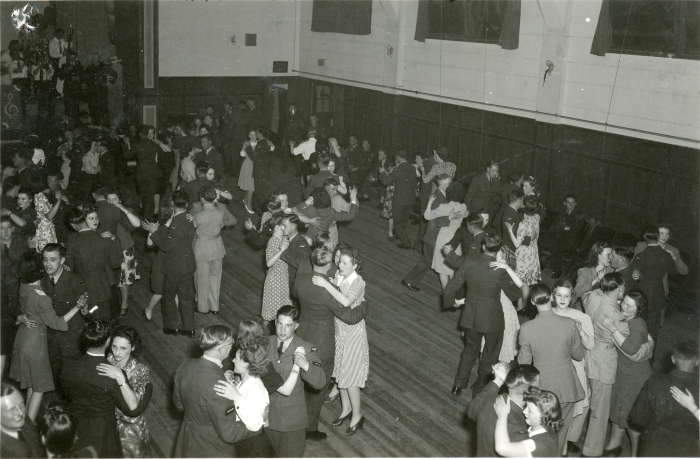
Social life on the base flourished, with officers hosting dances in the mess hall, accompanied by the Royal Canadian Air Force (RCAF) orchestra. Over the station’s operation, 1284 pilots graduated, majority from the RCAF. Tragically, twenty training fatalities occurred, with most buried in the Red Deer Cemetery.
Infrastructure development continued throughout the war. The RCAF assumed control of water and sewage systems in September 1941, followed by workshops and heating plants in January 1942, and the Link Trainer and radio building in July 1942. A runway extension and perimeter taxi track were completed in October 1943. A new Station Church was dedicated in March 1944, and a bowling alley opened in April.
By mid 1944, Allied air supremacy reduced the demand for aircrew, and the BCATP began winding down. The RCAF announced the closure of No. 36 S.F.T.S. for December 1944; by October the last Oxfords had departed, and RCAF personnel had left.
Red Deer Archives, P21402
Postwar Transition and Civilian Use
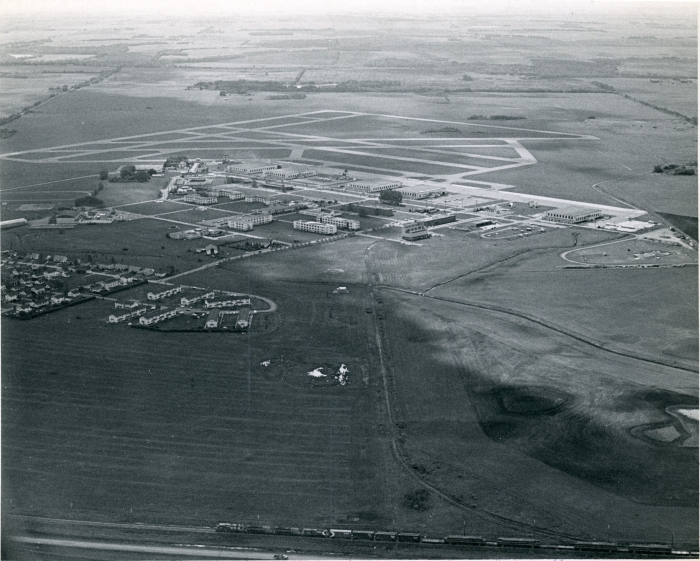
Following the school’s closure, RCAF Station Penhold hosted No. 2 Technical Signals Unit from November 1944 to summer 1945, employing about 200 technicians to maintain electronic equipment across western Canada. In August 1945 operations moved to Calgary and Penhold was placed on care and maintenance status. On August 31, 1945, the RCAF declared the station surplus, and on November 30, 1945, the federal Department of Transport assumed control. Postwar deliberations determined which airfields would be retained for civilian use. Penhold was designated for permanent retention early on. However, the Department of Transport soon contracted the demolition of most buildings, sparing only the hangars. The RCAF continued using several hangars until 1950, while others were repurposed or left unused. The airport was relicensed for civilian operations in August 1950.
Red Deer Archives, P18950
NATO Training and Cold War Expansion
In November 1949, Canada offered to train North Atlantic Treaty Organization (NATO) aircrew, and Penhold was selected for this program. The RCAF re-assumed control of the airport and initiated extensive reconstruction, including land expropriation and rebuilding nearly all station facilities. The base was reactivated on May 12, 1952, though construction continued into 1954 when the family housing area was dedicated as Mynarski Park in memory of air gunner Andrew Mynarski, VC.
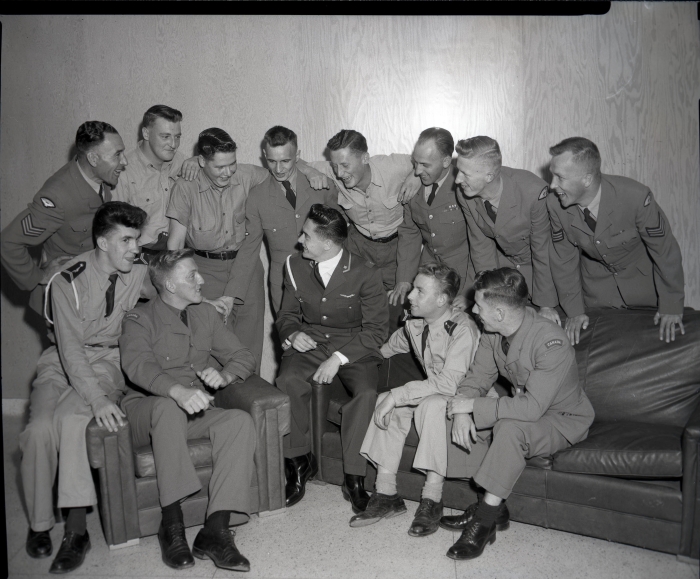
Postwar flying operations began with the arrival of a Beechcraft Expeditor on December 17, 1952. Training evolved as NATO agreements expired; some courses included only RCAF trainees, while others served Royal Canadian Navy pilots under the “Venture” plan. By 1963, the station housed 526 military personnel and 234 civilians, operating 68 Harvard and two Expeditors aircraft.
On September 24, 1963, the Department of National Defence announced that Penhold would not receive jet trainers, and flying training would end with the Harvard’s retirement. Penhold became the last Canadian station to operate the Harvard, with its final flight on July 21, 1965, piloted by Wing Commander F.P. Clark in Harvard Mark 4 No. 20370. This aircraft was later purchased by the City of Red Deer and presented to the base in 1968.
Red Deer Archives, N6079
CFB Penhold
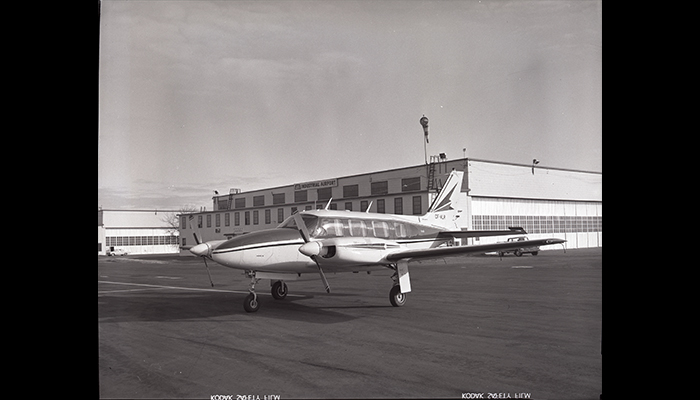
Although the airfield ceased military air training it continued operations and was renamed Canadian Forces Base (CFB) Penhold in 1966. CFB Penhold hosted numerous programs, including the Air Defense Command School, Refrigeration Maintenance School, Hail Research Project, RCMP Training School, Canadian Forces Junior Leader School, and Air Reserve National Training School.
CFB Penhold also continued the tradition of Air Cadet summer camps, dating back to the Second World War. In the 1960s, these camps added a national scholarship flying program for gliders and light aircraft. By 1966, the Penhold Air cadet Summer Training Centre had expanded to serve all western Canada, training approximately 1,700 cadets.
South of the base, a 77,000 sq. ft. semi-underground Regional Emergency Government Headquarters and Provincial Warning Centre bunker, often called a “Diefenbunker,” became operational in 1964 after secret ground-breaking in 1961. Until completion, staff and equipment operated from the Penhold base barracks. 743 Communications Squadron was established in 1966 and housed in the bunker until it became non-operational in 1993, when the squadron moved to CFB Calgary in 1994. The bunker was sold in 1995, subsequently reacquired, and demolished in 2001.
The CFB Penhold was downgraded to a detachment of CFB Edmonton in 1990 and officially closed in 1994. The residential area, Mynarski Park, was renamed Springbrook in 1995 after sale to private developers, while the former base lands were marketed as Harvard Park.
Access the research guide to learn more about CFB Penhold.
Red Deer Archives, N4370